
How to Belt
ABSTRACT
Belt is a high energy voice quality that uses a natural association of certain acoustics to portray heightened emotion. It is NOT forceful and produced well it presents no risks. There are, however, significant differences between Belt and other voice qualities, in particular those used in Classical singing. Proper understanding and application of breathing patterns, body engagement and acoustics is essential to producing a healthy and efficient Belt.
What is Belting? by Andy Follin
Of all the voice qualities, Belt is the one that seems the least understood, and surrounded by the most mystique.
Ironically, Belt quality is possibly the most natural way of using the voice, as it's what children are doing every day in the school playground - without losing or damaging their voices.
Although the word 'belt' can mean 'to hit something hard', Belt quality is not a forceful way of using the voice.
Proper Belting technique can best be described as a refined, skilful yell or call. In everyday life, we yell or call in situations of heightened emotion - excitement, anger etc. Belt makes full use of this association with high emotional stakes, which is precisely why it's such an exciting sound.
But while there are similarities between yelling / calling and Belt quality, it's definitely not shouting, which is done with an abusive amount of breath pressure. Neither is it 'Chest Voice' pushed higher.
Often, people use the term 'belt' to indicate any loud sound. This, again, tends to lead to singers pushing an unhealthy amount of breath against the vocal folds, resulting in fatigue, hoarseness and potentially more serious vocal problems.
Next time a Musical Director, coach or band member asks you to 'belt it out', try to work out if they mean 'belt' or 'Belt' - with all due respect, they may not know the precise difference.
Can anyone Belt?
Absolutely. Understanding the precise vocal set-up opens up a whole new world of repertoire. No matter what your previous training, you can learn to Belt, by isolating the correct components of the voice and learning to control them.
A song would rarely be Belted from beginning to end, but in every song there comes a moment when nothing else will do - the audience will accept nothing less. Put simply, if you want to sing in Musical Theatre, Rock and Pop (in other words, anything other than a Classical / Operatic quality), you have to know how to Belt.
Belting explained
To understand Belt fully, we need describe it in terms of two related but separate elements - the anatomy (how the singer produces it) and the acoustics (what the audience hears).
The anatomy of Belt
Belt is loud. Uncompromisingly loud!
the loudness of Belt does not come from an increase in air pressure
This comes from using the vocal folds in a certain vocal register, and shaping the vocal tract in a very specific way.
Belt quality uses short, Thick vocal folds (M1 in register terms), a short vocal tract (the larynx is held in a relatively high position) a narrowed AryEpiglottic Sphincter (AES or epilarynx), a wide, lateral internal mouth shape with high, forward tongue and a high degree of Torso Anchoring.
This 'set up' means that the vocal folds stay closed for longer during their vibration, which in turn requires a decrease in air pressure i.e. you use much less breath to Belt than to sing in other Voice Qualities.
It's important to emphasise this: the loudness of Belt does not come from an increase in air flow, but from a longer closed phase. Using Classical breath strategies in Belting can result in problems - hence why so many Classical teachers describe Belt as dangerous and wrongly discourage its use.
The acoustics of Belt
Belt is bright, brassy and exciting! As discussed above, these are inherent qualities in a natural call or yell. The challenge for the Belter is to maintain those qualities above a normal speaking range. For most singers, singing higher often results in an abrupt change of quality, where the voice suddenly gets softer and more 'hooty'.
Kenneth Bozeman in 'Practical Vocal Acoustics' describes these two distinct sounds as 'Yell timbre' and 'Whoop timbre'. You can experience them both by first calling across to an imaginary friend on an energised (but not pushed!) 'Hey!', then calling 'Yoo hoo!' on a higher pitch. This should put you into Yell and Whoop respectively.
Maintaining Yell timbre is key to the acoustics of Belting.
For this to happen, the pitch and resonance have to be very precisely balanced - if that balance slips, the voice 'cracks' or 'breaks' into Whoop timbre - the uncontrolled 'Yodel'.
Formants and Harmonics
When you sing, the vibration of the vocal folds produces a pitch and overtones. The sound produced by the vocal folds is amplified and resonated in the vocal tract (throat and mouth) which can be shaped to emphasise or dampen those overtones.
Overtones are known as Harmonics (H).
Vocal tract resonance areas are known as Formants (F) and are how we differentiate vowel sounds and Voice Qualities.
Both Harmonics and Formants are numbered from low to high - hence H1, H2, F1, F2 etc.
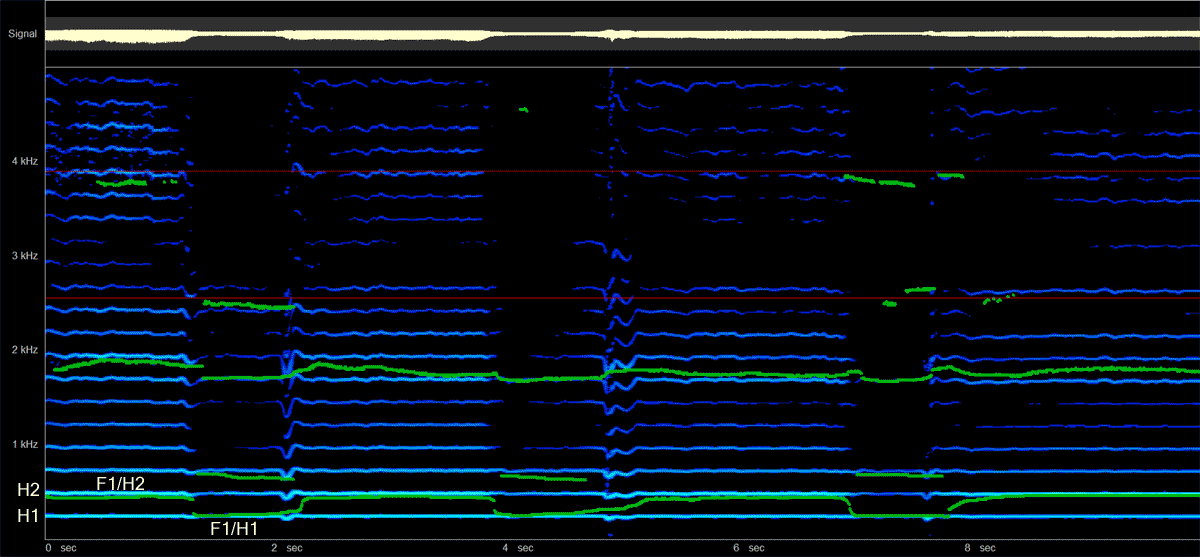
Yell and Whoop can be described acoustically in very specific terms, as explained in the panel above. Yell timbre (and therefore Belt) is defined acoustically as a strong first formant (F1) tracking of the second Harmonic (H2) whereas Whoop is a strong first formant (F1) tracking of the first Harmonic (H1)
- Yell is F1/H2 tracking
- Whoop is F1/H1 tracking
It's beyond the scope of this article to go into much detail about Formants and Harmonics but Andy is more than happy to discuss these principles with you in your lessons, using tools like the Voiceprint spectogram (see below) to show you what you hear.
The Belt recipe
Putting all the above together gives us a very specific anatomical and acoustic definition of Belting:
- Thick Vocal Folds
- High Larynx
- Narrow AES
- Spread Lips
- Relaxed Jaw
- Forward Tongue
- Engaged Torso
- Reduced Air flow
- F1/H2 Tracking
Although this information is useful in terms of defining Belt from a scientific perspective, Belt is best learned by experiencing the sounds and sensations.
Estill Voice Training™ is taught via individual Figures for Voice™ that are designed to give you full, independent control over the structures of your voice such as the Vocal Folds, Larynx position, AES and Anchoring mentioned above. Andy would ensure you have mastered each of the Figures in isolation before encouraging you to Belt.
Is Belt dangerous?
Produced properly, Belt poses no risks. It's a high energy method of singing, though, so if the perfect conditions are not maintained, it could be harmful for the voice. But the same could be said for Opera quality, so Belt is no more dangerous than Classical singing.
Whatever style you want to sing in, it's vitally important that you know exactly how to use the voice to its best effect, without causing undue tension and strain. That's why Estill Master Trainer (EMT)s of Estill Voice Training™ spend years understanding how to teach each unique style -giving you complete control and freedom in your singing.
Are there different types of Belt?
As discussed earlier, 'belt' is a term often used to describe any loud sound. The physical and acoustic definition of Belt quality given above (M1 register, F1/H2 tracking) is what we can refer to as an Estill Belt, or 'Pure Belt'.
However, if we accept that any loud sound could be described as a form of belt, we could consider other options, two of which are given below.
NB to help you understand the following, it would be useful for you to read or review vocal registers explained first.
Mix Belt
Mix belt would maintain the same F1/H2 tracking, but the vocal folds would be in a vibration mode known as 'Mix' or 'Voix Mixte'.
- Read article: What is the 'Mixed' voice?
In this case, the voice would still be in an M1 register, but with less of the vocal fold depth involved in the vibration, an 'M1 minus' register or Mx1.
Twang Belt
Twang belt would again maintain the same F1/H2 tracking, but the vocal folds would probably be in a Thinner condition (M2) This is very similar to the Mix belt, the difference being that there would be a greater reliance on the intensity and resonance boost that comes from narrowing the AES.
This provides more back pressure and increases vocal fold resistance, meaning that the M2 vibration is reinforced - an 'M2 plus' register or Mx2.
Learn to Belt
Andy is a full-time, professional vocal coach, not a school teacher, singer or pianist giving a few singing lessons in their spare time. Unlike a lot of voice teachers, Andy does not insist on long-term tuition, where students have to attend regular lessons, repeating the same exercises until their voice improves. You can attend as often as you like, but there's no compulsion to attend every week or every fortnight. In fact, many students only book sessions every 4 to 6 weeks.
Estill Voice Training™ is known for producing quick results. Quite often, Andy finds that long-standing problems can be fixed in the first few lessons. At your first session, Andy will give you an assessment of your abilities and draw up a plan that ensures you get to where you want to be, as quickly as possible.
If you're ready to take your voice to the next level, book a lesson with Andy today (see bottom of page).
Andy runs his studio from St Helens, so is ideally located for students in the Liverpool, Merseyside, Manchester, Lancashire and Cheshire areas. Please check out the separate pages for students from Liverpool, Merseyside, Warrington, Widnes / Runcorn, Wigan, Cheshire, Lancashire and North Wales.
For those unable to travel to the studio, or who are based overeseas, Andy is also happy to teach online via Zoom. During the 2020 lockdown, Andy was able to continue teaching in this way to provide full service to his clientele. For more information on the equipment needed for an effective Zoom lesson, please check out the Online Lessons page.
Become the singer you've always wanted to be
Discover your true potential and take control of your future